# Interest Calculation

Interest can be calculated for certain account recurring charges, usually bonds. For example, you may require accounts to pay a monthly bond amount, but give them interest on the amount. To do this, you would:

1. Set up a recurring charge code (such as “bond”) to charge a certain amount on account invoices in each specified billing period. If you want a single, one-time charge (say 50.00) you could still have it be a recurring charge, but make the maximum charge 50.00. For more information about specifying charge amounts, see Account in the Setup Manual.
2. Set up a miscellaneous charge code (such as “bondint”) that does not update Accounts Receivable, but updates the balance of the charge code in step 1 (“bond”). For more information about setting up charge and credit codes, see Charge/Credit Code in the Setup Manual.
3. Calculate the interest each month (or whatever your interest period is) using this option. You specify the interest percentage here, and the amount is added to the associated recurring charge’s account during billing processing.
4. When the carrier leaves the route, you can find the total amount that was charged for bond (the recurring charge plus interest) by running the Charge/Credit Report. Then you can enter a miscellaneous credit for the account. The miscellaneous credit code (for example, “bondout”) should update the bond charge (“bond”), but also apply to AR.

Business Rules determine whether the interest calculation should include previous unbilled interest, the current recurring charge amount, and whether unbilled miscellaneous charges and credits that update this charge account.

{% hint style="info" %}
**Note:**

*Interest calculations may increase a account’s “maximum amount” (see Account in the Setup Manual) for a recurring charge balance. For example, if the account’s “maximum amount” is 150.00, interest calculations might cause the total to be 152.00.*
{% endhint %}

If you do give interest on bonds (or any other charges), calculating interest should be part of your account billing run.

To perform the interest calculation:

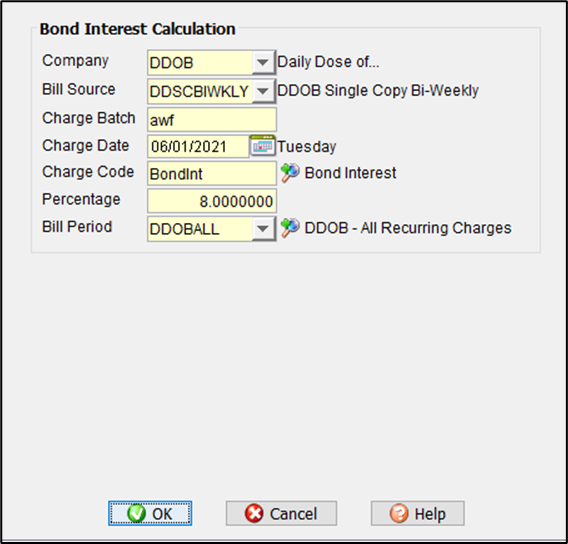
* Select Interest Calculation from the Account Billing menu to display the Bond Interest Calculation window.\ <br>

  <figure><img src="/files/581og6mEhXmSVsGiMQPx" alt=""><figcaption></figcaption></figure>

* Click Add and complete the following fields.<br>

  <table><thead><tr><th width="150">Field</th><th width="150">Type</th><th width="372.2">What to enter</th></tr></thead><tbody><tr><td>COMPANY</td><td>setup</td><td>Enter the company for which interest should be calculated.</td></tr><tr><td>BILL SOURCE</td><td>setup</td><td>Enter the bill source for which interest should be calculated. A bill source is a group of carriers which you want to bill together (examples are Carrier and Dealer).</td></tr><tr><td>CHARGE BATCH</td><td>open (10)</td><td>Enter a batch name for the interest charges.</td></tr><tr><td>CHARGE DATE</td><td>date</td><td>Enter the date when the interest charges should be created.</td></tr><tr><td>CHARGE CODE</td><td>setup</td><td>Enter the charge code(s) for which the interest should be calculated. The only valid charge codes to use are the ones that update the balance of another charge code. Press F2 for a lookup of valid choices.</td></tr><tr><td>PERCENTAGE</td><td>decimal (11)</td><td>Enter the interest percentage; for example, enter 3 for 3%.</td></tr><tr><td>BILL PERIOD</td><td>setup</td><td>Enter the bill period of the recurring charges that should be included in this interest calculation, such as “every”, “weekly” or “monthly”. Interest will only be calculated on charges in this bill period.</td></tr></tbody></table>

* Click OK and then Continue to perform the interest calculation.

* When the calculation is complete, the Bond Interest Calculation Report is displayed, listing the accounts where interest was applied.

#### Example—Bond Interest Calculation Report

<figure><img src="/files/WfZQqscpf9tc2tcsyKpD" alt=""><figcaption></figcaption></figure>


---

# Agent Instructions: Querying This Documentation

If you need additional information that is not directly available in this page, you can query the documentation dynamically by asking a question.

Perform an HTTP GET request on the current page URL with the `ask` query parameter:

```
GET https://docs.navigaglobal.com/circulation-user-manual/accounting/account-billing-menu/interest-calculation.md?ask=<question>
```

The question should be specific, self-contained, and written in natural language.
The response will contain a direct answer to the question and relevant excerpts and sources from the documentation.

Use this mechanism when the answer is not explicitly present in the current page, you need clarification or additional context, or you want to retrieve related documentation sections.